
Leg Armor
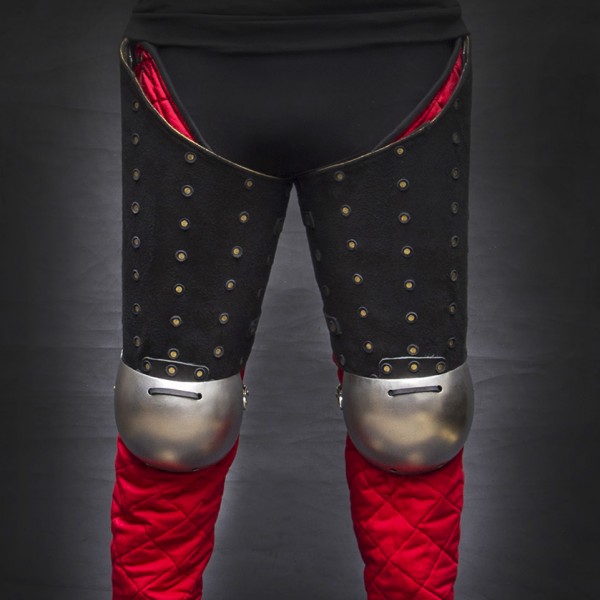
Brigandine cuisses completed with steel knees cops. The plates are made of 1.5mm cold rolled steel and are also available in 1.0mm and 1.5mm stainless or tempered steel as well as titanium. Each plate is covered with black paint on both sides to provide additional protection against rust. The knee cops have protective paint layer
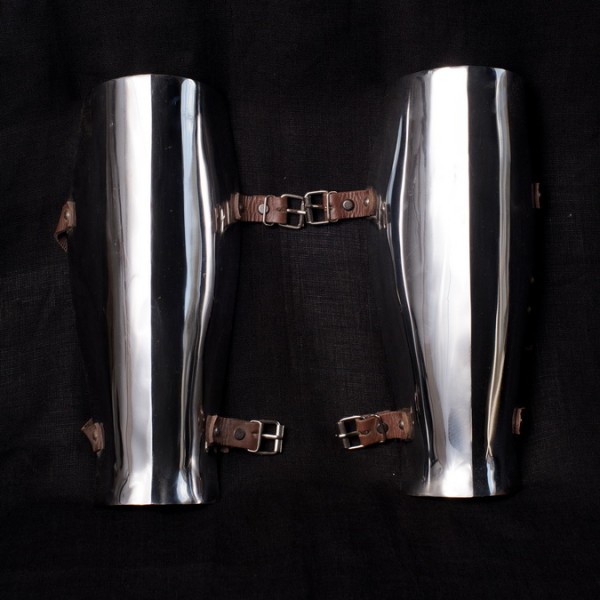
If you’re in the market for comfortable leg armor that comes with a small price tag, you’re in luck! Made of 1.5mm cold rolled steel, this armor has excellent protection qualities and gives you good mobility. Our Front Greaves are equipped with leather straps and are easily fastened with the help of buckles. Upgrades are
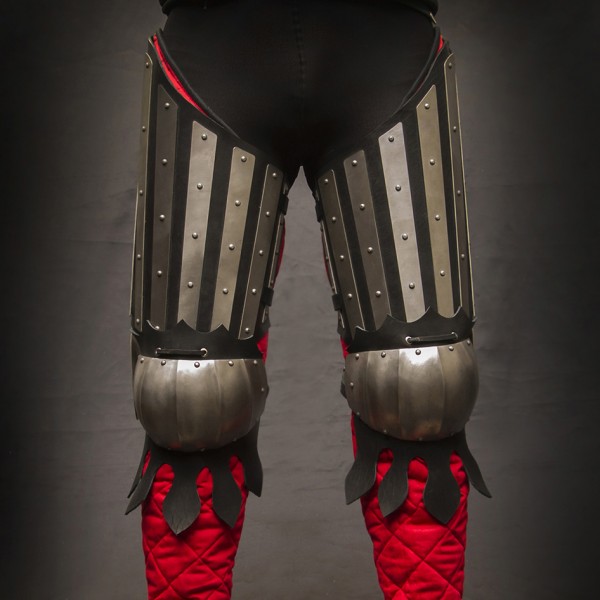
Splinted cuisses crafted according to XIV to late XV century design and completed with fluted steel knee cops. These leather cuisses are reinforced with metal bars which provide great protection and flexibility. The steel elements are made of 1.5mm cold rolled steel (base option) and 4mm durable brown leather. They are also available in 1.0mm
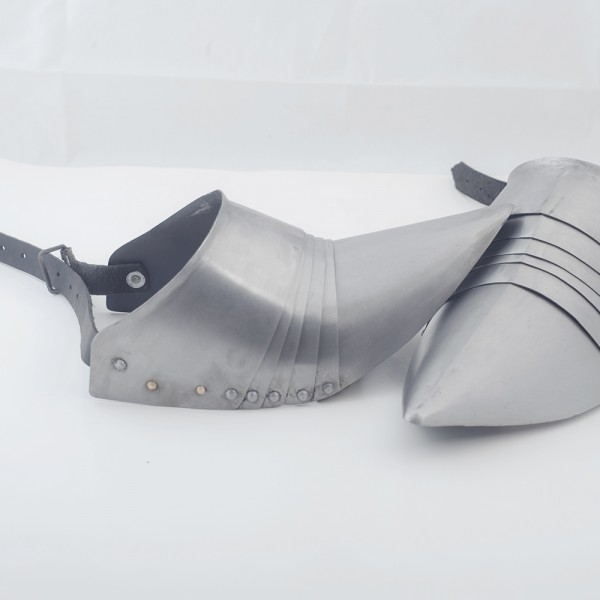
This stylization of the sabatons of the French king Charles VI (1368-1422) is based on an example which is preserved in Chartres Cathedral in France. They have taped points and are adapted for full contact medieval battle. Riveted steel lames provide excellent mobility and flexibility. Sabatons are an essential part of full leg protection and
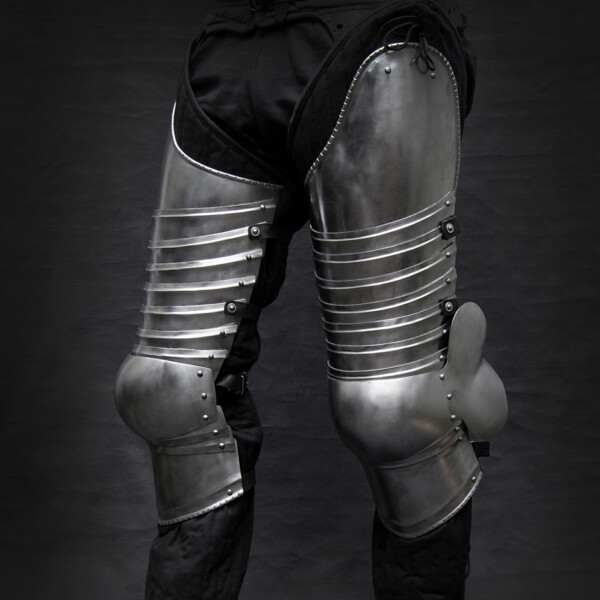
Greenwich armours – it’s XVI century armor made in Royal Almain Armoury (Greenwich Armoury) founded by Henry VIII the King of England in 1511. Though Greenwich armors were made by hired German blacksmiths, researchers single them out into a separate group of the English style armors. Greenwich Leg Armor consists of cuisses and knee protection. This model
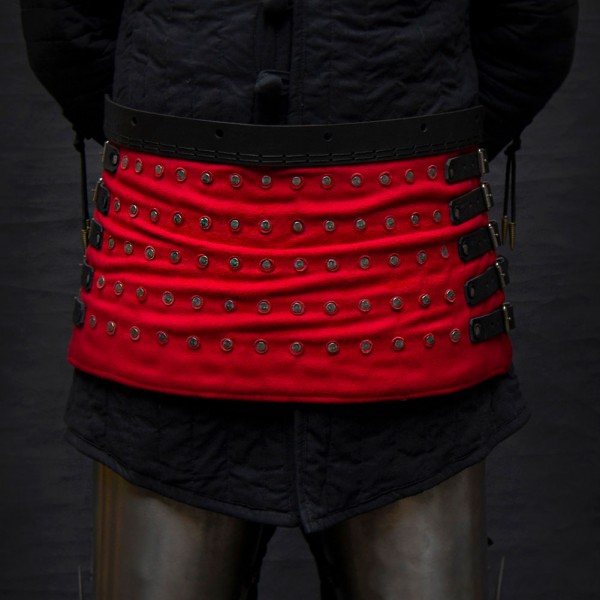
This Brigandine skirt was made from 1.5mm mild steel. Covered with red wool. It has two rows of leather straps on the sides. You can regulate the comfortable fit. Overlapping articulated steel lames. The thick leather top with holes so you can fix brigandine skirt on the gambeson. Brigandine skirt is an addition to your
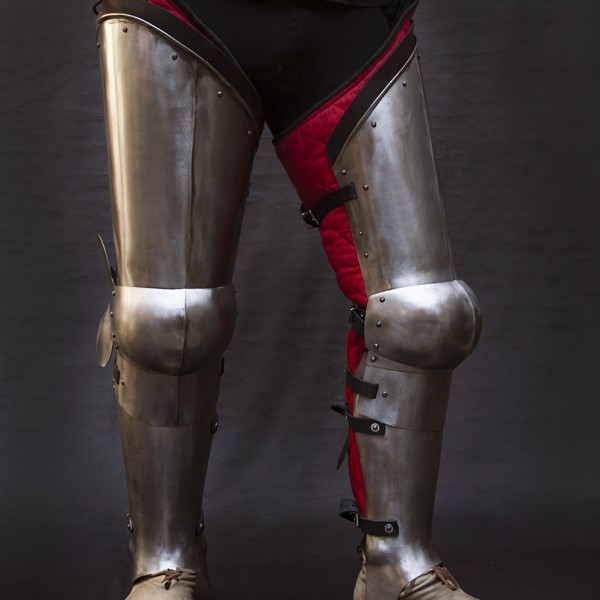
In Medieval Europe, full leg armor protection usually consisted of the cuissardes (thigh protection), kneecaps, greaves (shin protection) and sabatons (foot protection). The completed leg harness was an essential part of the full plate armor. It developed from the formed metal plate that served as knee protection. The knees were the most important and vulnerable
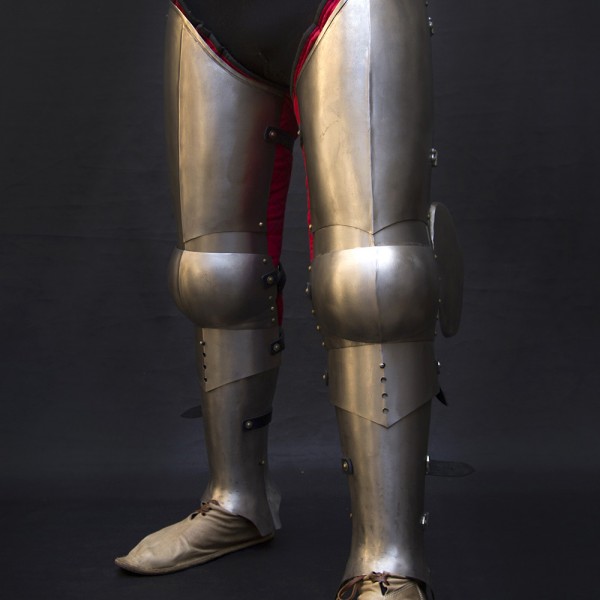
Nearly all commonly used elements of medieval armor (protection for the head, arms, torso, and legs) were designed by the first half of the XIV century. Only a few “new” details and elements were added during the last half of that century. By the XV century, armor had evolved to become what we know as “full plate
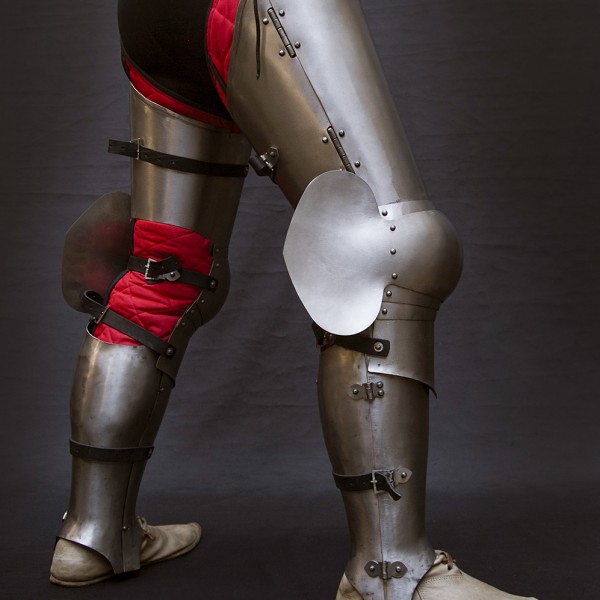
The history of leg armor is the story of how mail stockings transformed in to a full plate leg harness. The first element appeared in the XII century. It was a simple knee protection: a round dish-shaped metal scale sewed upon leather. At the beginning of the XIV century the hauberk became shorter and shorter.
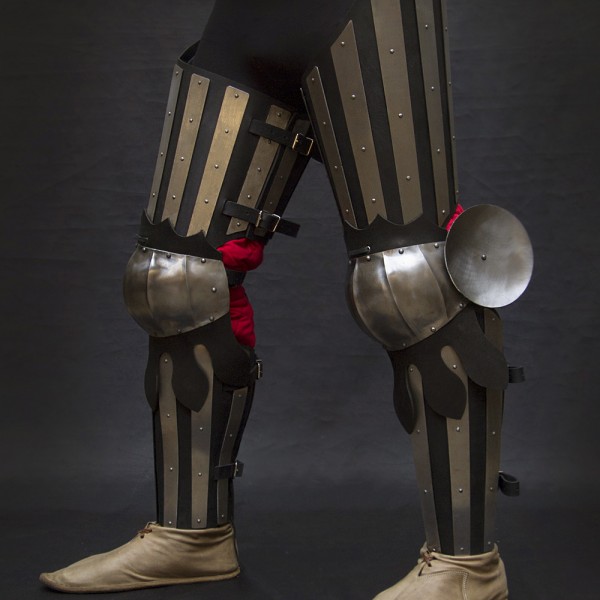
Our Splinted Full legs are crafted with both protection and comfort in mind. They consist of a set of Splinted Cuisses with Knees and Splinted Greaves, combined here for ease of purchase. Please note that measurements should be with padding/gambeson.
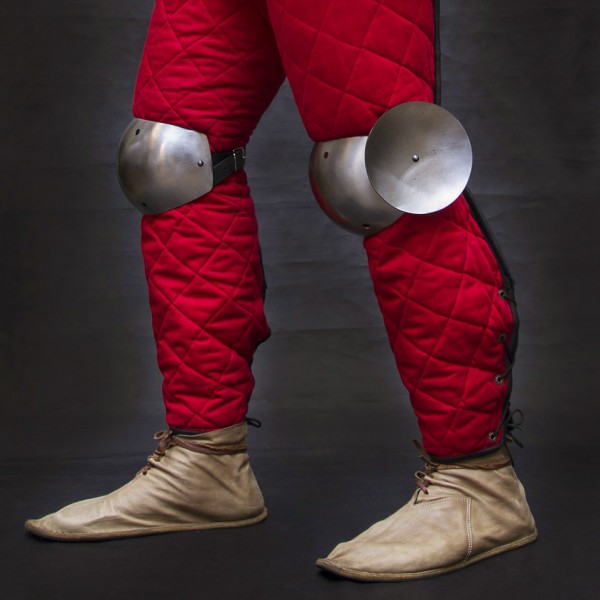
Our Steel Knees Type-2 is standard design from the XIV – early XV centuries. It boasts side protection in the form of rondels and is equipped with leather straps. Two pairs of holes are drilled on the top and bottom so that the caps are easily affixed to your padding or other elements of armor
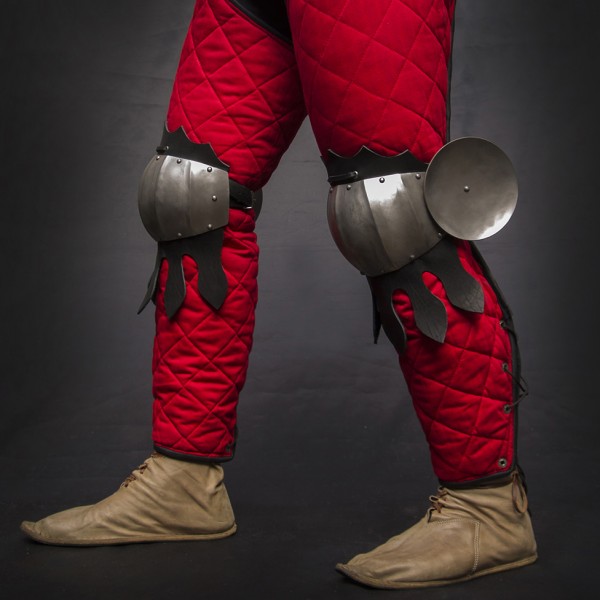
Steel Kneecaps – which are known as “Kneibuckel” in German, “ginocchielli” in Italian, and “genouillères” in French – are assumed by some historians to be the first step toward full plate leg harnesses. Knee coverage with plates was essential and the rest of the leg followed from there. During the XII century, knights used chainmail
Medieval Leg Armour
Only knights and cavalry could afford full leg armor back in the Middle Ages. Infantry and other soldiers could only count on leather and brigandine leg armor. Of course, after big battles, the soldiers engaged in looting and removing their fallen enemies’ trophies. These, however, were isolated cases because the lion’s share of the trophies were usually taken by the warlords.
Show more...
This lack of leg armor was the reason that most injuries sustained during combat were limb injuries. Add to that mix the horrible medicine that was prevalent in the Middle Ages, and you get a huge percentage of deaths due to limb injuries.
During periods of peace, the rulers did everything to keep the military training of knights at a proper level. One of the ways to do that was to set up tournaments. There was a little problem, however – knights often died in the tournaments, which was obviously not the way rulers would want it. Therefore, rules were put in place which allowed only non-sharpened weapons. The spectators naturally wanted more blood, but at the same time, they realized this kind of entertainment could also be interesting and warmed up to the new rules.
There were many varieties of tournaments. There were those in which the knights didn’t need full leg armor. This kind of tournament was called “through the pole.” During this type of battle, the combatants were located on either side of a pole. The pole itself was set parallel to the ground at approximately belt level. As a result, knights could only hit above the belt since leg kicks and strikes were not possible. There were also other kinds of tournaments that required good leg armor as strikes there were permitted, and the combatants required full protection. Several hundred years have passed, and full-contact battles are of increasing interest and are gaining more and more viewers.
Everyone who is engaged in, or thinking about HMB and IMCF full-contact fights should approach choosing their equipment as seriously and responsibly as possible. Beginners typically want to cover their hands and arms first, expecting their opponents to hit the upper limbs more. However, our battle experience shows that fighters actually get more injuries they could’ve avoided if only they had adequately armored legs. It’s also important not to overlook the fact that high-quality articulated plate armor will increase your confidence in both buhurt and duels especially during the times when it’s important to stand firmly on your feet or make a leap towards the enemy.
The majority of leg strikes fall on the upper leg armor and much fewer on lower leg armor, which is why we recommend using stronger materials on the upper leg. Nevertheless, greaves remain highly important as you are covering potentially open areas, allowing you to concentrate on your fighting technique and your opponent. Also, something to keep in mind, whether intentionally or accidentally, chances are you will still be hit in the gaps between armor elements despite the fact that it is forbidden. Hence the importance of durable leg armor that reduces gaps to the maximum extent possible.
We also can’t ignore sabatons! “Who’s going to hit my feet with a weapon?” you may ask. However, if you watch a buhurt, you’ll notice that if one falls down during the battle, the fight goes on, no one pays attention to you, and especially to where your feet are. However, they are open and any accidental impact is a threat. The fighters are focused on their enemies, not you. In this situation, even a member of your own team is as dangerous to you as an enemy if you don’t have sabatons.
Hopefully this piece has illustrated to you that full leg armor is an integral part of your battle equipment, and that lower leg armor is as important as upper leg armor. In addition, don’t forget to take care of your feet and put on sabatons.
Forge of Svan has been manufacturing medieval plate legs since 2004. We have extensive experience with splinted leg armor as well as leather leg armor. Therefore, don’t delay – get your battle protection! Your opponents ordered their armor from us a long time ago, which is they are so confident. Get yours today!
less..
 Shop
Shop